The deliverable
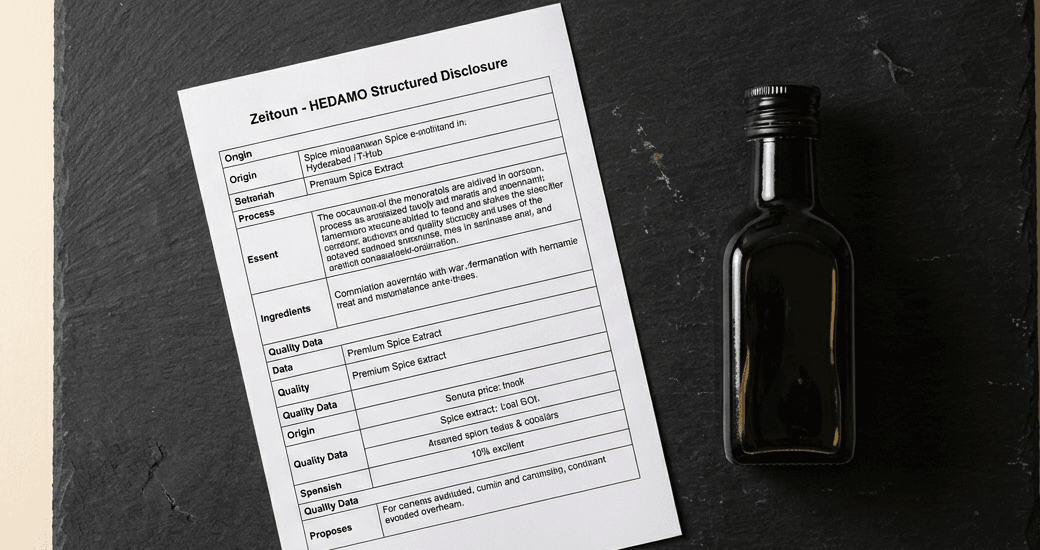
A structured disclosure for one product. One document. Producer-declared, source-attributed, gap-visible.
The methodology below is what makes the document consistent across producers and readable across markets.
- 01OverviewWhat the structure holds and who owns what.
- 02Disclosure structureEight fields. What each one carries.
- 03Source and attributionHow claims are linked to evidence.
- 04Claim ownershipProducers declare. Jurisdictions decide. HEDAMO maintains.
- 05Disclosure alongside operationsHow disclosure sits beside certification, traceability, and regulation.
The structure that lets information travel.
What a product profile carries.
Geographic and agricultural source of the product.
Production and cultivation methods declared by the producer.
How the product was handled between field and final form.
Producer-declared attributes: health, quality, heritage, and more.
Documentation supporting each claim.
Frequency and methodology of product testing where declared.
Fields not completed, testing not conducted, or documentation not provided.
Version history: when the disclosure was last updated and what changed.
A gap in a HEDAMO disclosure is a visible methodological position. It may mean information was not declared, testing was not conducted, documentation was not provided, or the field is incomplete. Readers see the gap. They do not see an inference.
Where information is not declared, HEDAMO marks the gap rather than converting absence into judgment.
Health is not reduced to nutrition facts. It includes origin, practices, processing, and use context.
How sources are attributed.
Every claim can carry source attribution. Where it is absent, that absence is visible.
“Where a source, test, or method is not declared, HEDAMO does not infer. It marks the gap and moves on.”
Who owns what.
HEDAMO may structure the presentation of the claim, but it does not become the author, validator, or endorser of the claim.
HEDAMO does not make that decision. It does not position disclosures as pre-approved or accepted.
HEDAMO maintains the schema: what fields exist, how they are organised, and how gaps are marked.
Where disclosure sits alongside operations.
Certification evaluates against thresholds.
Disclosure structures what the producer declares.
These functions coexist.
Traceability tracks movement through a supply chain.
Disclosure structures what the product is at any point in that chain.
Both are needed.
Regulation determines admissibility.
Disclosure makes producer-declared information legible to the regulator.
The decision remains with the jurisdiction.
Laboratory testing generates evidence.
Disclosure gives that evidence a structured, portable home alongside the producer's own declarations.
Existing systems perform essential operational functions. HEDAMO structures a disclosure layer so that producer-declared attributes become portable across buyers, institutions, and markets, without relocating operational responsibility.
A product can be fully compliant and still poorly understood.
How HEDAMO sits alongside existing systems.
How HEDAMO sits alongside existing systems.
HEDAMO vs Certification
HEDAMO vs Traceability
HEDAMO vs Labelling
HEDAMO vs Compliance
Terms used with precision.
Show glossary · 5 terms
Producer-declared information
Information about a product that has been stated by the producer. It is not verified by HEDAMO. It is not inferred from external sources. It is what the producer has chosen to declare within the disclosure schema.
Product information portability
The capacity of product information to remain readable, comparable, and useful as it moves across markets, institutions, procurement contexts, and research frameworks. The primary goal of the HEDAMO disclosure structure.
Structured disclosure
A disclosure organised according to the HEDAMO schema: defined fields, declared gaps, source attribution, and version history. Distinguished from unstructured product documentation by its consistency and portability.
Methodology gap
A field in a disclosure schema where information has not been declared, testing has not been conducted, or documentation has not been provided. A methodology gap is visible to readers, marked and presented as an honest position, not inferred or filled.
Admissibility vs intelligibility
Admissibility is whether a product or claim meets the regulatory, procurement, or market standards of a given jurisdiction, a decision that belongs to that jurisdiction. Intelligibility is whether the information about a product can be understood by a reader in that context. HEDAMO structures for intelligibility. It does not determine admissibility.
Show all terms
Disclosure
A structured document containing producer-declared information about a product, organised according to the HEDAMO schema. A disclosure is not a certificate, rating, or marketing document.
Portable product information
Product information that has been structured so it can travel, remaining intelligible to different readers in different contexts without requiring re-explanation by the producer.
Source confidence
The declared basis for a claim within a disclosure. Not a score. A property showing what documentation, testing, or record supports a given declaration, and where that support is absent.
Claim ownership
The principle that every declaration in a HEDAMO disclosure belongs to the producer who made it. HEDAMO does not author, validate, or endorse claims. Accountability for what is declared rests with the producer.
Sample disclosure
A demonstration disclosure used to show the HEDAMO schema applied to a real product. A sample disclosure is not a certificate, rating, or marketing document, and does not constitute an endorsement of the product it describes.
Disclosure workspace
The Disclosure Workspace is a proposed working environment for creating and updating structured disclosures. It is shown as a preview, not a live service.
HEDAMO is a disclosure methodology developed by Altibbe Inc. Altibbe Research publishes the Structural Gaps in Product Information Systems series that informs the methodology.
The methodology earns trust through what it structures — and what it refuses to claim.